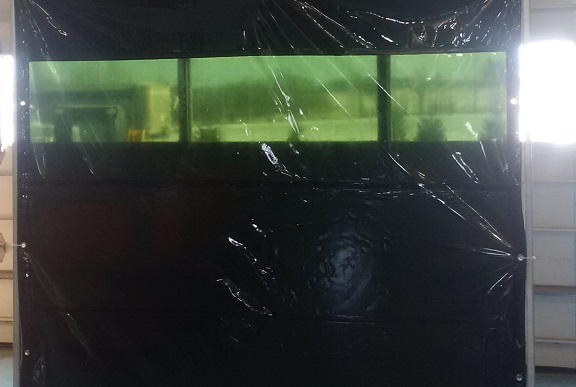
Welding screens & curtains · Care and replacement guide
A welding screen's job is invisible: the tinted vinyl absorbs the ultraviolet light from the arc so people nearby can work, walk past, and supervise without being burned. The problem is that the protection wears out on a different schedule than the panel itself. A screen can hang straight, look clean, and still be quietly losing the chemistry that made it protective — and no law in the US or Canada will ever tell you the day it expired, because no law sets one.
The short answer
There is no legally mandated replacement age for welding screens in the United States or Canada, and no standard sets one either. Replacement is condition-based: inspect regularly, and take a screen out of service when it fades, stiffens, cracks, or is holed. The only published service-life figure from a major manufacturer is a vendor estimate of about 7–10 years for vinyl curtains, depending on use (Singer Safety). If your screen is older than that, of unknown age, or shows any warning sign below, the honest answer is that its protection can no longer be verified — and, as we'll show, there is no inexpensive test that can verify it either.
01 · Degradation
Why a welding screen wears out
A welding curtain is flexible PVC vinyl loaded with flame retardants, pigments, heat and light stabilizers, and — critically — UV-absorbing additives. The protection lives in that formulation, not in the plastic itself: clear vinyl sheeting blocks essentially no UV at all (one major maker labels its clear curtain, in so many words, "does not block any UV radiation"). Everything that attacks the formulation attacks the protection. Four mechanisms do most of the damage:
1
The arc's UV breaks down the PVC itself
Welding-arc UV is far more intense than sunlight. It drives chemical reactions in the PVC (dehydrochlorination and photo-oxidation) that produce progressive yellowing, then orange, red, and brown discoloration, surface roughening, micro-cracking, and loss of flexibility — the well-documented signature of aging PVC in the polymer literature. When a yellow or red screen changes color, the chemistry is changing. That is not cosmetic wear; it is the material degrading.
2
The UV-absorbing additives get used up
UV absorbers and stabilizers work sacrificially — they absorb energy and are themselves consumed over time. Polymer research is blunt about it: these additives "also deteriorate over time, and eventually the polymeric material degrades." A screen's UV-blocking capacity can therefore decline before the film shows structural failure.
3
Plasticizer migrates out, and the film turns brittle
The plasticizers that keep vinyl flexible slowly diffuse to the surface (the sticky film you sometimes feel on old vinyl) and evaporate. What's left behind is stiffer and more brittle, and plasticizer loss also makes the PVC more vulnerable to further chemical breakdown. Heat accelerates all of it — and radiant heat near an arc can locally exceed the roughly 150 °F (65 °C) maximum that manufacturers rate these curtains for.
4
Spatter, ozone, and cleaning take their toll
Hot spatter pits and burns the film. Arc UV generates ozone in the surrounding air, another oxidizer. And aggressive solvent cleaners attack vinyl directly — curtain-care guidance is to use only cleaning agents approved for the material, because the wrong cleaner is itself a form of degradation.
An honest caveat
No published study has tracked the UV transmittance of welding curtains over years of real shop service, so nobody can hand you a curve that says "a five-year-old screen blocks X%." What the evidence supports is this: the degradation pathways are real and documented, the standards world treats optical drift as a genuine failure mode (EN ISO 25980 requires a curtain to still meet its UV limits after accelerated arc-like exposure), and fading, discoloration, and stiffening are the practical, visible proxies for a screen whose protection is in decline. They are warning signs, not a calibrated gauge — which is exactly why the guidance everywhere is to replace on condition rather than trust appearances.
02 · Health stakes
What a tired screen lets through
The person a welding screen protects is usually not the welder — it's everyone else: the forklift driver passing the bay, the apprentice watching technique, the customer in a small shop. The signature injury is arc eye (photokeratitis), a UV burn of the cornea. Canada's CCOHS describes symptoms from a sensation of pressure and "sand in the eyes" to intense pain, tearing, bloodshot eyes, and an inability to tolerate light. Two features make it treacherous: seconds of intense UV exposure can be enough, and symptoms are delayed by several hours — bystanders typically don't connect the exposure to the pain until that evening, so a degrading screen can overexpose people for weeks before anyone blames it.
Beyond arc eye: UV causes skin erythema — plain sunburn — on unprotected skin, and chronic UV exposure is associated with cataracts and increased skin-cancer risk (NIOSH). Intense visible light adds glare, eye fatigue, and headache. One hazard screens are not really managing is infrared: at the distances screens are used (a meter or more from the arc), arc IR is below hazardous levels, which is why the international product standard sets no IR requirement at all.
Physical damage is the bluntest failure of all. A pinhole, burn-through, or tear passes the unattenuated arc — a bystander behind a holed screen is, at those spots, simply unprotected, and spatter can reach them too. And remember what a screen is: protection against incidental exposure for people at a distance. It is never a welding filter, and never a substitute for the welder's own helmet and eye protection.
03 · Color & shade
Yellow, green, or red — what the color does and doesn't tell you
It surprises many buyers: no standard assigns meanings to curtain colors. EN ISO 25980 grades curtains purely by how much visible light they transmit, and AWS F2.3M's criteria are likewise based on the material's measured performance, not its tint. Color conventions are manufacturer practice:
Yellow is the brightest shade — commonly recommended for low- to medium-amperage work where supervisors want good visibility into the cell. Orange and red sit in the middle, for medium amperage. Dark green (and the darkest shades) are marketed for the highest-risk work, including plasma cutting. The main thing darker shades add is control of visible and blue light — the glare band — rather than a fundamentally different class of UV protection.
Measured data backs that up: Tillman publishes spectral curves showing all of its curtain colors — yellow, green, orange, blue, gray — blocking 99% or more of UV in the 200–400 nm band. You may encounter the claim that yellow screens are mere "spark arresters" that don't reduce UV; that is a competitor's marketing line and it is contradicted by manufacturers' spectrographic data and by a 2026 peer-reviewed study (Dain, Sliney & Naumov), which found lighter shades can meet ISO 25980:2023 without compromising safety.
The honest conclusion cuts the other way, though: because protection comes from formulation, a tint alone guarantees nothing. A properly formulated yellow curtain is a real welding curtain; an unlabeled screen of any color, from an unknown maker, has unverified protection — not zero, not proven. Which brings us back to inspection and age.
04 · Inspection
Take it out of service when you see these
Manufacturer and standards guidance is consistent on the warning signs. Any one of these means the screen comes down — for repair where repair is genuinely possible, and for replacement where it isn't:
Fading or color change
Yellowing, darkening, or patchy discoloration — visible evidence of the polymer and additive breakdown described above.
Stiffness or brittleness
Vinyl that no longer flexes like it did, feels boardy, or crinkles — plasticizer has left the film.
Cracking or crazing
Surface cracks, crazed patches, or eroded, rough areas anywhere on the panel.
Pinholes & burn damage
Spatter pits, burn-through, holes, or tears. Each one is a direct line of sight to the unfiltered arc.
Warping & edge failure
Distorted panels, delamination, damaged seams and eyelets/grommets, frayed or rotting edges — gaps are exposure paths.
Grime that won't clean off
Contamination that can't be removed without harsh solvents; embedded soiling can also compromise flame retardancy.
How often? No standard or manufacturer we found publishes a fixed inspection interval. A defensible routine: a quick visual check before use, a deliberate hands-on inspection on a schedule (monthly is reasonable in a daily-use shop), and an extra look after any spatter incident or cleaning. Flex the material gently as part of the check — stiffness announces itself to your hands before your eyes. Pair this with the age guidance below: an older screen earns closer and more frequent scrutiny.
Should you replace yours? A 30-second check
Answer from what you know about your screen. Every answer is color-coded, and the colors are the verdict:
All green — your screen likely has no concerns. One or more yellows — age or wear is starting to count; replacing the screen may be warranted. One or more reds — the screen should likely be replaced.
1 · How long has the screen been in service?
2 · Which warning signs have you noticed? (pick the most serious that applies)
3 · How hard does it work?
Based on the condition-based guidance summarized on this page — manufacturer inspection advice and the one published service-life estimate of roughly 7–10 years for vinyl curtains. When in doubt, the tiebreaker is simple: a screen is inexpensive; an eye injury is not.
05 · Testing
Can you test a used screen? We looked hard for a cheap way
It would be tidy if a $30 gadget could certify an old screen. We reviewed the three routes owners actually ask about — laboratory testing, handheld meters, and indicator cards — against what the standards require: hazard-weighted effective UV transmittance under 0.002% and blue light under 1.0%, measured spectrophotometrically. Here is the honest scorecard.
Laboratory spectrophotometry
The real test · no published price; single-sample lab work typically runs to hundreds of dollars
This is how it's properly done — the method behind ISO 25980 conformance and the 2026 study that tested 27 commercial curtains. Optical labs will measure spectral transmittance, but they quote per job, and the arithmetic is unforgiving: lab-testing a used curtain costs several times what replacing it does — and replacement is a modest purchase (our minimum order is $99).
Verdict: valid, but uneconomical for an owner. Realistic for manufacturers, importers, and disputes — not for deciding whether to keep a screen.
Handheld UV meter
≈ US $249 · e.g. Solarmeter Model 5.0 (280–400 nm)
A broadband UV radiometer can compare readings with and without the curtain under a stable lamp, and gives a rough "still blocking most UV" indication. But it cannot verify the standard: its reading isn't the hazard-weighted figure the limits are written in, it can't resolve a 0.002% criterion, it misses the 200–280 nm band entirely — and the welding arc itself is not a stable test source (striking one "for a test" exposes the operator to the very hazard).
Verdict: a gross sanity check at best. It cannot tell you a screen still complies — or still protects to the standard.
UV cards & cheap proxies
A few dollars · UV indicator/dosimeter cards, UV flashlight tricks, lux-meter comparisons
Indicator cards show that UV is present — qualitatively. A flashlight test probes one wavelength. Comparing an old panel against new stock with a light meter measures visible fading, which doesn't map to UV performance either way: PVC can stay a strong UV absorber while visibly faded, and UV additives can deplete with little visible change.
Verdict: none of these can quantify protection against the limits that matter. Interesting, not evidence.
The bottom line on testing
There is no inexpensive, reliable field test by which a screen owner can verify that a used curtain still meets protective limits. That is not a sales line — it is where the standards, the test-lab economics, and the instrument physics all land. The approach the evidence supports is the one manufacturers and standards point to: inspect on condition, and replace on a sensible age-and-condition schedule rather than waiting for proof of failure that no affordable tool can give you.
06 · Law & standards
What the rules actually require — and what they don't
Much of the confusion around replacement comes from blurring three different things: binding law, voluntary consensus standards, and things that are neither. Separated out, the picture is clear.
"Employees and other persons adjacent to welding areas shall be protected from the rays by noncombustible or flameproof screens or shields or shall be required to wear appropriate goggles."
— OSHA 29 CFR 1910.252(b)(2)(iii), the core US federal requirement
Source
What it says
Replacement age?
Law · US federal OSHA 29 CFR 1910.252
Workers and others adjacent to welding must be protected from the rays by noncombustible or flameproof screens/shields, or wear appropriate goggles. In fully screened spaces, screens must not seriously restrict ventilation (mounting ~2 ft above the floor is "desirable" unless the work requires otherwise). Resistance-welding rules (§1910.255) similarly require shields or curtains against flying sparks.
None. No inspection frequency, condition standard, replacement interval, age limit, or labeling requirement.
Law · Canada (provincial) Alberta OHS Code s.231 · BC OHS Reg. s.12.122 · Manitoba WSH Reg. s.17.5
Arc welding must not expose another worker to arc radiation unless that worker wears suitable eye protection or is protected by a screen, curtain, or partition. Manitoba references CAN/CSA-W117.2 for protective equipment.
None. No fixed-year replacement and no date-marking mandate in any federal or provincial provision reviewed.
Standard · US AWS F2.3M:2019
Specification for Use and Performance of Transparent Welding Curtains and Screens — covers testing, selection, and safe use; curtains give people "at some distance" a safe view of the operation. (Full text is paywalled; no fixed replacement age appears in any accessible source describing it.)
None found.
Standard · US ANSI Z49.1 §4.1.1
Adjacent workers protected from radiant energy and spatter by noncombustible or flame-resistant screens or shields, or PPE. Notes that radiation-protective semitransparent materials are permissible and screens should allow air circulation at floor level and above.
None. No inspection or replacement interval.
Standard · Canada CSA W117.2
Canada's consensus standard for safety in welding, cutting, and allied processes; referenced by provincial regulation for PPE. (The publicly accessible excerpt covered PPE clauses; the bystander-screen wording could not be verified from it.)
None found in any source describing it.
Standard · International EN ISO 25980:2023 (comparison — not US/Canadian law)
The most specific product standard: effective UV transmittance < 0.002%, blue light < 1.0%, four luminous-transmittance grades, after 100 h in an arc-like xenon chamber the curtain must still meet the limits with luminous change within ±20%, self-extinguishing flame behavior, designed for use at least 1 m from the arc — and explicitly not a welding filter for looking at the arc.
None — but it is the one standard that formally treats optical drift with age/exposure as a failure mode. Its predecessor (EN 1598) required marking including month and year of manufacture; whether the 2023 edition mandates the same could not be verified from the public sample.
Neither "Replace every X years" rules
Despite how often a fixed interval is repeated in shop lore, we found no US federal or state law and no Canadian federal or provincial regulation that mandates replacing welding screens after a set number of years, and no law requiring date-of-manufacture labeling on welding curtains. Date and maker markings exist as standard-conformity practice, not legislation. Employers remain under general duties to maintain safe equipment — condition-based, not age-based. (Research covered federal rules and representative provincial/state sources; an exhaustive sweep of every state-plan and territory was not performed, and no fixed-year rule surfaced anywhere.)
—
One practical consequence for buyers: a screen with no markings at all — no maker, no standard reference, no date — cannot be shown to conform to AWS F2.3M or ISO 25980, whatever its actual quality. If conformance matters for your shop's safety program or insurer, buy marked screens from a maker who publishes test data. If you already own unlabeled screens, the sections above and below are how you manage them responsibly.
07 · Service life
So how long does a welding curtain actually last?
Ask the manufacturers and the striking thing is how few numbers exist. No established maker publishes a mandatory replacement interval. What we found:
Singer Safety is the only major maker we found that puts a figure on it: vinyl welding curtains last "around 7–10 years" depending on usage, with welding UV itself shortening life — replace sooner on any sign of damage, wear, fraying, rotting, or unrepairable holes. Treat this as what it is: a vendor estimate, not a standard, and "depending on usage" is doing real work in that sentence. A screen beside a high-amperage production cell lives a harder life than one in a home shop used monthly.
Goff's Enterprises offers a 5-year warranty on its curtain-wall systems (and lifetime on track hardware) — a warranty against defects, not a service-life prediction. Steiner publishes UV-blocking and fire-marshal compliance claims and a maximum temperature of 150 °F, but no replacement interval. Tillman publishes its 99%+ UV-blocking spectral data and flame approvals (FM 4950, NFPA 701, California Fire Marshal), likewise with no interval. Wilson/3M: no lifespan statement found.
Putting it together into practice: treat 7–10 years as the outer planning horizon for a vinyl screen in regular service, replace immediately on any warning sign regardless of age, and shorten the horizon for screens that work close to the arc, see high amperage, or live in heat. A screen of unknown age with unknown history should be treated as an old screen.
08 · The unlabeled screen
Your screen has no date on it. Now what?
Plenty of perfectly serviceable screens — including ones sold as general-purpose vinyl panels — carry no label, no maker mark, and no date of manufacture. Nothing in US or Canadian law requires that marking, so an unlabeled screen isn't an illegal one. But it does leave you without the single most useful piece of maintenance information: how old it is. Three habits close that gap:
1. Date it yourself, starting today. When any screen goes up — new or already in service — write the date on the frame and on an edge of the vinyl with a paint marker, and log it wherever your shop keeps maintenance records. From then on, age is a fact, not a guess.
2. Treat unknown age as old age. If a screen was already hanging when you arrived, has no date anyone can vouch for, and shows even early warning signs — the first fading, the first hint of stiffness — replacement is the defensible call. Screens are among the cheapest safety devices in a welding shop.
3. Keep a known-good reference. When you replace a screen, keep a small offcut of the new material (stored out of sunlight) with its date noted. Comparing the in-service panel's color and flexibility against that reference at each inspection turns "has it faded?" from an impression into a comparison — the one genuinely useful low-tech check available, while remembering it speaks to visible condition, not certified UV performance.
09 · Questions
Frequently asked questions
Is there a law that says welding screens must be replaced every few years?
No. We found no US federal or state law and no Canadian federal or provincial regulation that sets a replacement age for welding screens, and no consensus standard sets one either. Laws (OSHA 1910.252; provincial OHS rules in Alberta, BC, Manitoba, and others) require that people near welding be protected by screens or eye protection — they say nothing about screen age, inspection schedules, or date labels. Replacement is condition-based: inspect, and replace on the warning signs.
Can I test my old screen with a handheld UV meter?
Only as a rough sanity check. A meter like the Solarmeter 5.0 (~US $249, sensing 280–400 nm) can show a curtain still blocks most lamp UV, but it cannot produce the hazard-weighted measurement the standards use, can't verify the 0.002% UV limit, and misses wavelengths below 280 nm. It cannot certify a screen as still protective. Laboratory spectrophotometry can, but typically costs several times the price of a new curtain — and a new curtain is inexpensive (our minimum order is $99).
My screen has faded but has no holes. Is it still protecting people?
Nobody can promise you that it is. Fading is visible evidence of the polymer and additive breakdown that erodes UV protection, which is why manufacturers list discoloration as a replace-on-sight sign. Faded doesn't automatically mean zero protection — the relationship isn't calibrated — but since no affordable test can measure what's left, a faded screen should be planned for replacement, not trusted indefinitely.
Are yellow screens less protective than green or red ones?
Not inherently. Color is a convention, not a rating: standards grade curtains by measured light transmission. Tillman's published spectral data shows its yellow curtains blocking 99%+ of UV (200–400 nm), and a 2026 peer-reviewed study found lighter shades can conform to ISO 25980:2023. What matters is the maker's formulation and verified test data — an unlabeled screen of any color has unverified protection. Darker shades mainly buy glare control for higher-amperage work.
How far from the arc should a screen be?
EN ISO 25980 curtains are designed for use at least 1 m (about 3 ft) from the arc, and the researchers behind the 2026 curtain studies recommend that point-of-sale guidance accompany the products. Closer placement means more UV dose, more heat, and more spatter — all of which shorten the screen's life as well as testing its limits.
Can a welding screen replace a helmet or goggles for watching?
No. Curtains are engineered for incidental exposure of passersby at a distance. AWS's own guidance states they are not intended as welding filter plates, and ISO 25980 says the same. Anyone intentionally watching the arc, or working near it, needs rated eye protection.
10 · Place an Order
Ready to order?
Custom welding curtains are made to your exact measurements — the configurator prices your size live.
Researched October 2026. Standards text behind paywalls (AWS F2.3M, CSA W117.2, ISO 25980 Clause 6) is summarized from publishers' public samples and abstracts, as noted in the text; where a point could not be verified from a primary source, the page says so.